
doBoard vs Asana
Best Asana Alternative in 2026: doBoard
doBoard is an Asana alternative without per-seat pricing: $5/month for unlimited users, projects, and tasks.
Time tracking, workload planning, sprints, and Planning Poker are included on every plan. No seat bundles, no feature tiers.
Unlimited users. Unlimited projects. One flat price.
- Tasks, boards & projects
- Time tracking
- Workload & capacity
- Sprints & Planning Poker
- Calendars & time zones
- Custom labels & workflows
Monthly price for a team of 20
Unlimited users and projects, time tracking included
20 seats × $10.99, billed annually; time tracking is a paid add-on
20 seats × $24.99, billed annually; adds time tracking and workload
$5 covers the whole team.
Pay $5/month; upgrade only if you need more than 5 GB of storage.
Short answer
doBoard is an Asana alternative for teams that want to stop paying per seat: $5/month for unlimited users and projects, with time tracking, workload planning, sprints, and Planning Poker on every plan. For a team of 20, Asana costs $219.80/month on Starter and $499.80/month on Advanced, billed annually. Asana remains the better fit for teams that need portfolios, goals, or Gantt charts.
4/5 from WP Mayor, with 5/5 for pricing, and 4.2/5 from CareerAddict. 5/5 from a Trustpilot reviewer who got resource planning and time tracking for the whole team. Built by CleanTalk and used by its own teams every day.
Quick comparison
doBoard vs Asana at a glance
| Category | doBoard | Asana |
|---|---|---|
| Price for 20 people | $5/month | $219.80/month on Starter, $499.80/month on Advanced |
| Pricing model | One flat price for unlimited users; grows only with storage | Per seat: $10.99 on Starter, $24.99 on Advanced; above 5 users, seats are added 5 or 10 at a time |
| Time tracking | Included on every plan | Included from Advanced; a paid add-on on Starter |
| Workload and capacity planning | Included on every plan | Project and portfolio workload on Advanced; company-wide capacity planning on Enterprise |
| Sprints and Planning Poker | Built in on every plan | Sprints through templates and custom fields; Planning Poker via a third-party app |
| Free plan or trial | No free plan; 7-day free trial, no credit card | Personal plan free for up to 2 users; free trial of Advanced, no credit card |
Pricing
Team cost examples: Asana vs doBoard
Asana charges per seat and adds seats in steps, so a growing team often pays for seats nobody uses. doBoard charges one price for the whole account.
5 people
$5/mo doBoard, 5 GB
- Asana Starter$54.95/mobilled annually
- Asana Advanced, with time tracking$124.95/mobilled annually
12 people Asana bills 15 seats
$5/mo doBoard, 5 GB
- Asana Starter, 15 seats$164.85/mobilled annually
- Asana Advanced, 15 seats$374.85/mobilled annually
50 people
$5/mo doBoard, 5 GB
- Asana Starter$549.50/mobilled annually
- Asana Advanced$1,249.50/mobilled annually
Asana prices are per user per month, billed annually. Billed monthly, Starter costs $13.49 and Advanced $30.49 per user. A team of 12 pays for 15 seats because between 6 and 30 users Asana adds seats 5 at a time. Every teammate in these examples is a paid Asana member; free guests are not counted.
What’s the catch?
There isn’t one. You pay for storage, not for people: every plan includes every feature and unlimited users, and the price changes only when you need more than 5 GB (20 GB is $15/mo, 750 GB is $300/mo). There’s no free tier for paying customers to cover and no big ad budget built into the price. doBoard is made by CleanTalk, a website security company trusted by more than 1.1 million websites.
7-day free trial. No credit card required.
Who it’s for
Is doBoard a good Asana alternative for your team?
doBoard fits teams that use Asana for everyday task and project work and pay for seats and tiers they don’t fully use. Here is who gets the most out of it, and when Asana is still the better choice.
Small and mid-sized teams tired of per-seat pricing
A team of 5, 20, or 50 pays the same $5/month. Hiring never forces a plan change or a bigger seat bundle.
See how doBoard helps small teams →Agencies and consultancies with many clients
Create a separate Company for each client in one account, with its own projects, people, access settings, and time logs. Clients see only their own work.
Learn how Companies work in doBoard →Teams that track time and plan capacity
Time tracking, estimates, available hours, and sprint capacity are on every plan, not behind Advanced or Enterprise.
See workload planning and time tracking →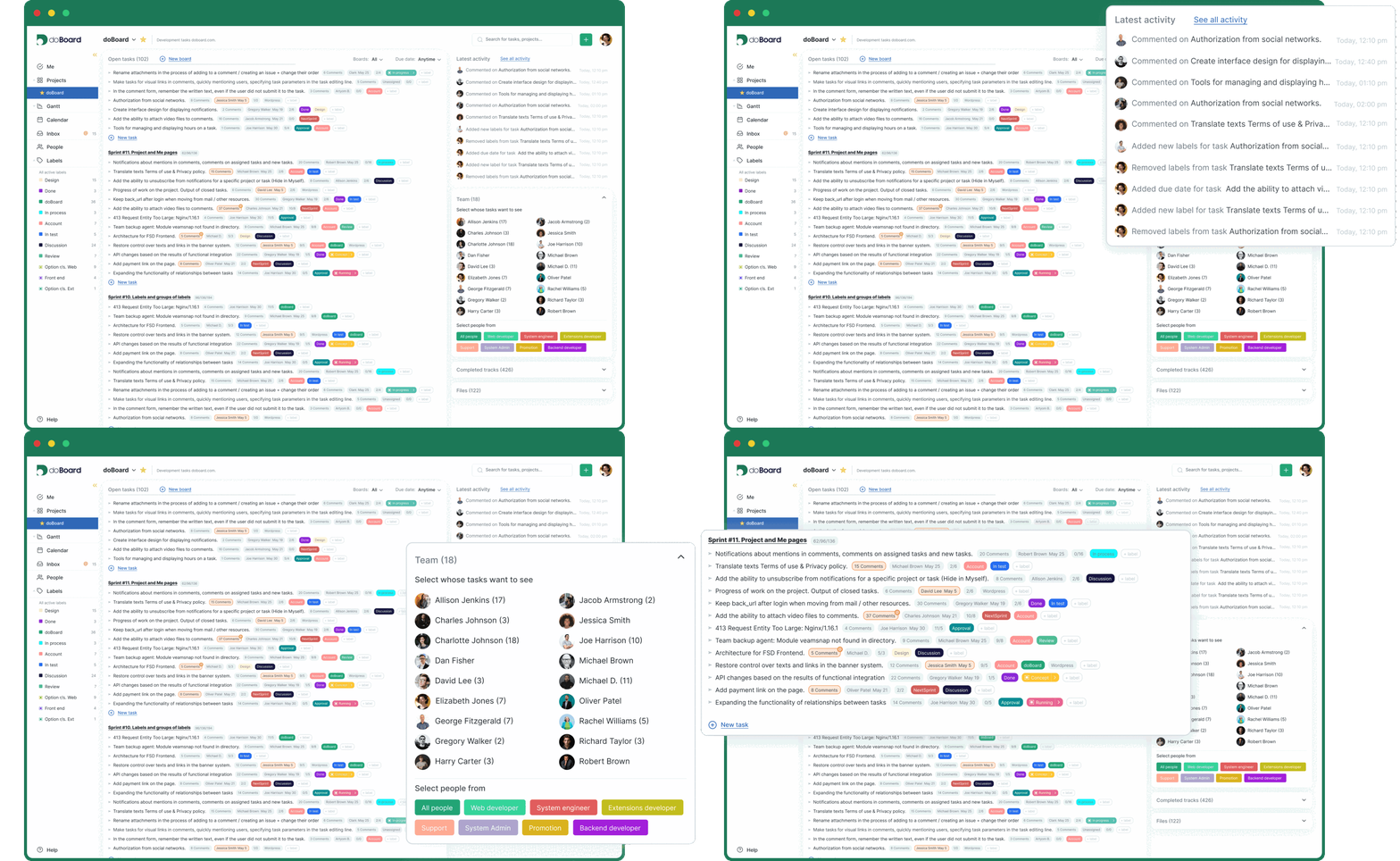
Development and Agile teams
Sprint boards, estimates, and Planning Poker are built in. The GitHub integration creates a doBoard task for every new issue, and Spotfix turns website feedback into tasks.
See how sprint planning works →Remote and distributed teams
Time zones, work hours, shifts, and an on-duty mention keep teams in sync across different schedules.
See doBoard for remote teams →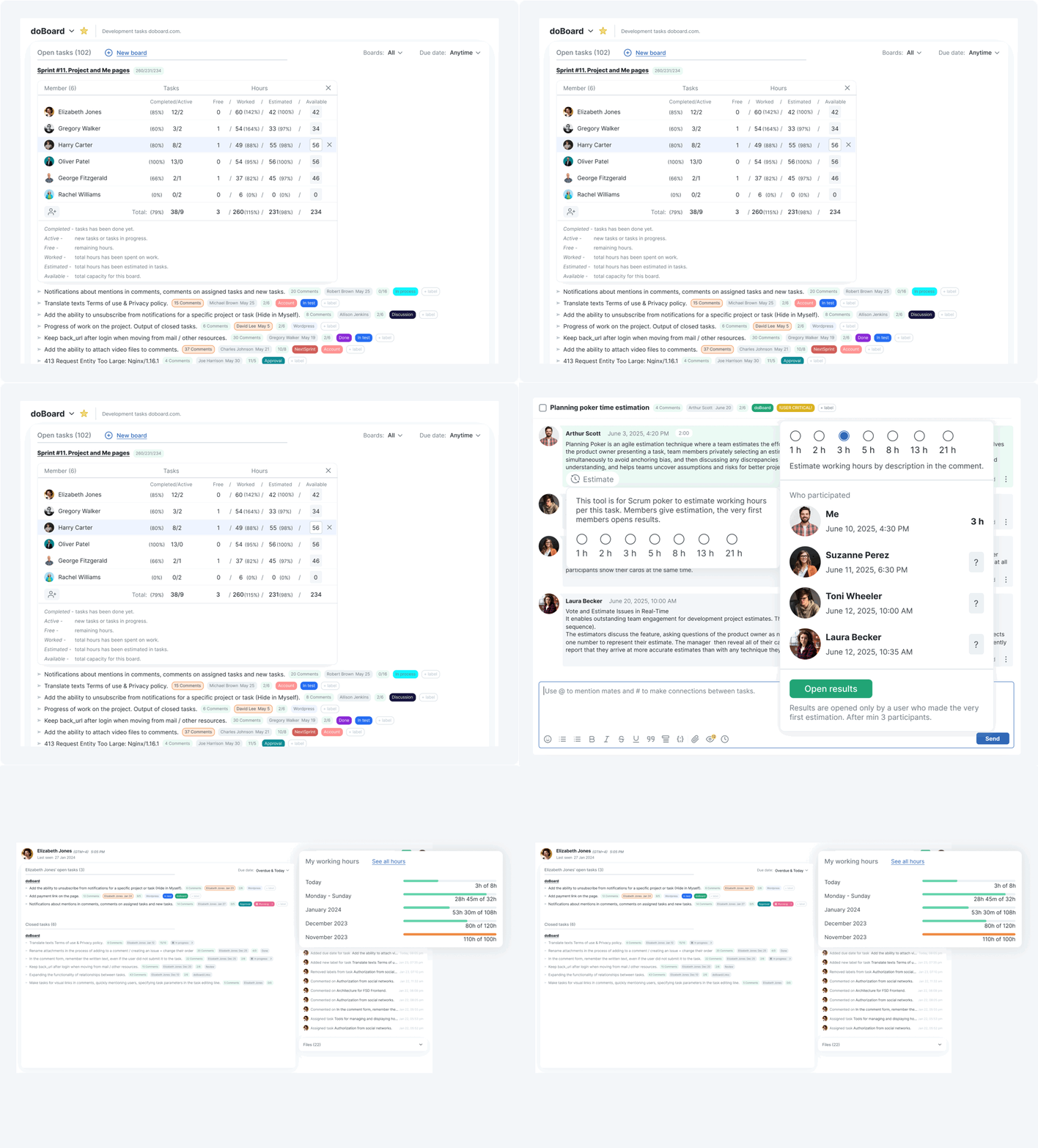
When Asana is still the better choice
- You manage portfolios, goals, and reporting dashboards across many departments.
- Your team plans every day on a Kanban board or a Gantt chart. doBoard has no Kanban view, and its Gantt chart is still in development.
- You work alone or in a pair, don’t plan to grow the team, and the basic features of Asana’s free Personal plan (up to 2 users) are all you need.
- You rely on integrations like Salesforce, Tableau, or Power BI.
Why doBoard
Why choose doBoard over Asana
One price for the whole team, not $10.99 per seat
Asana Starter costs $10.99 and Advanced $24.99 per user per month, billed annually, and above 5 users seats are added 5 or 10 at a time. doBoard costs $5/month for unlimited users, projects, and tasks, with every feature on every plan, so adding teammates never changes the bill.
Explore doBoard pricing →Time tracking without an upgrade or add-on
Asana includes time tracking on Advanced, at $24.99 per user per month billed annually; on Starter, it is the paid Timesheets and Budgets add-on. In doBoard, every plan logs time in tasks, compares estimated and actual hours, and reports hours by teammate, project, or period.
See time tracking in doBoard →See teammate workload and availability on every plan
doBoard shows each teammate’s planned and available hours in the task calendar, plus a team calendar with shifts and vacations, on every plan. In Asana, workload by project or portfolio starts on Advanced, and company-wide capacity planning is an Enterprise feature.
See workload planning in doBoard →Sprints and Planning Poker built in
Run boards as sprints, check capacity by teammate, and estimate tasks with Planning Poker inside the task: votes stay hidden until the reveal, and the final estimate stays with the task. In Asana, sprints run through templates and custom fields, and Planning Poker needs a third-party app.
See Agile features in doBoard →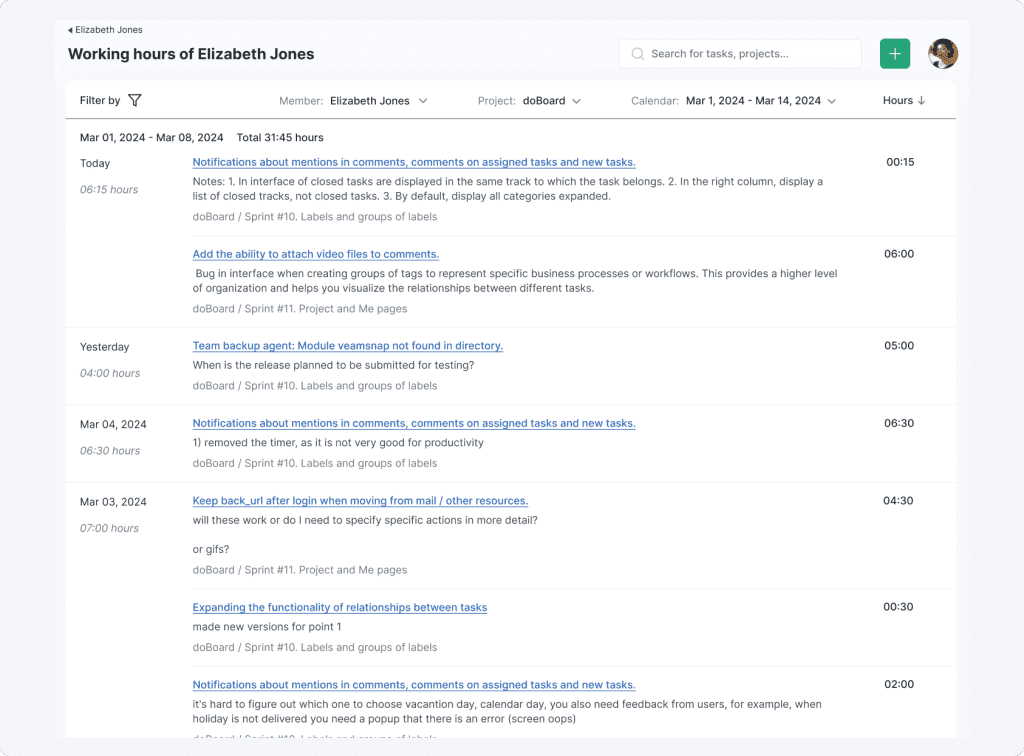
Full comparison
doBoard vs Asana comparison: features and pricing
Asana and doBoard both cover tasks, projects, and team collaboration, but they price them differently. Asana charges per seat and adds features plan by plan: timeline and Gantt views on Starter, time tracking and workload on Advanced, capacity planning on Enterprise. doBoard gives every plan unlimited users and every feature, and the price grows only with storage. The table compares both tools side by side.
| Category | doBoard | Asana |
|---|---|---|
| Price | $5/month for everything. The price grows only with storage: 5 GB — $5, 20 GB — $15, 75 GB — $50, 250 GB — $150, 750 GB — $300 | Per user per month: Personal $0 (up to 2 users), Starter $10.99, Advanced $24.99, billed annually ($13.49 and $30.49 billed monthly). Enterprise and Enterprise+: custom pricing |
| Users and seats | Unlimited users on every plan. Adding teammates, contractors, or clients does not change the price | Every member needs a paid seat, with 2 seats minimum. Seats are added 1 at a time up to 5 users, 5 at a time up to 30, 10 up to 100, and 25 up to 500. Guests are free in paid organizations but count as seats in workspaces |
| Projects and tasks | Unlimited projects, boards, tasks, and subtasks on every plan | Unlimited tasks and projects on every plan, including Personal |
| Storage | 5 GB on the $5 plan, up to 750 GB on higher tiers | Unlimited storage on every plan, up to 100 MB per file |
| Views | Task lists grouped into boards, a task calendar, and a team calendar. No Kanban board view; a Gantt chart is in development | List, board, and calendar views on every plan. Timeline and Gantt views from Starter |
| Time tracking | Built in on every plan. Log time in task comments, compare estimated and actual hours, and review hours by task, teammate, project, or period. No automatic timer | Included on Advanced and higher. On Starter, the paid Timesheets and Budgets add-on; on Personal, time-tracking integrations |
| Workload and capacity | Every plan: a task calendar with each teammate’s planned and available hours, a team calendar with shifts and vacations, and sprint capacity by teammate | Project and portfolio workload on Advanced. Company-wide workload and capacity planning on Enterprise and Enterprise+ |
| Agile and sprints | Boards as sprints and backlogs, time estimates, Planning Poker with private votes and the Fibonacci scale, sprint planning by teammate | Sprints run through templates, boards, and custom fields. Planning Poker is a third-party app in the Asana app directory |
| Workflow customization | Custom labels, tag groups as workflow stages, and due dates that update automatically when a task moves to the next stage | Custom fields, forms, templates, and unlimited automations from Starter; approvals, proofing, and form branching on Advanced |
| Reporting, portfolios, goals | No portfolios, goals, or dashboards. Estimated and worked hours are reviewed by board, project, and teammate | Reporting dashboards from Starter. Portfolios and goals from Advanced |
| Client work | A separate Company for each client in one account, with its own projects, people, and access. Clients see only their company or project | Unlimited free guests in paid organizations. Guest invitation permissions on Enterprise |
| Integrations | GitHub integration, the doBoard API, and Spotfix, a website feedback widget that turns comments into tasks | 100+ free integrations, including Slack, Google Drive, and Zoom. Salesforce, Tableau, and Power BI on Advanced |
| Deployment | Cloud. Self-hosting available in Beta | Cloud only. Asana does not plan to offer a self-hosted version |
| Free plan and trial | No free plan. 7-day free trial with every feature, no credit card required | Personal plan free for up to 2 users (some older free accounts allow up to 10). Free trial of Advanced, no credit card required |
For small and mid-sized teams, doBoard covers the everyday work Asana is used for, such as tasks, projects, time tracking, workload, and sprints, at one flat price. Asana Starter is a reasonable fit for small teams that need timeline views, forms, and automations and don’t track time. Asana Advanced and Enterprise make sense for companies that manage portfolios and goals across departments and are ready to pay per seat for it.
If you need software like Asana but cheaper, with time tracking and capacity planning on every plan and a price that doesn’t grow with your team, doBoard is the stronger fit.
7-day free trial. No credit card required.
Explore doBoard pricing →See all doBoard features →Asana prices and plan details come from asana.com/pricing, including the seat increments in its FAQ, and from Asana’s help center on subscriptions and guests and free trials. Planning Poker for Asana is a third-party app in the Asana app directory. doBoard is our product; its prices are on doboard.com. Prices and plan details may change and can vary by region. Last checked: .
Our story
Built by a team that works in doBoard every day
doBoard is made by CleanTalk Inc. Our own development, support, operations, product, and marketing teams plan and track their work in doBoard, so new features are tested on real projects first. We built it for teams that need clear tasks, built-in time tracking, and realistic sprint plans, without paying per seat.
80–100%
of planned sprint work finished by the deadline after our team moved to doBoard
Before the move: 55–65%
CleanTalk team data, shared by CEO Denis Shagimuratov
Reviews
What users and reviewers say about doBoard
TrustpilotRating: 5/5
“doBoard works well for us because it skips the complicated features we don’t actually need. We can add as many contractors and clients as we want without the price going up, which makes collaboration a lot easier. For what we pay, we are getting a lot more out of the tool than we initially expected. We didn’t expect to get resource planning and time tracking for the whole team for so little money.”
MariaLat, April 20, 2026
Read the full review on Trustpilot
WP MayorRating: 4/5, pricing 5/5
“Overall, doBoard offers a clean, intuitive interface for managing to-do lists and projects. While it lacks some advanced features, it’s simple to use and affordable. This makes it an appealing option if you need to boost your productivity and ‘shake up’ your task management.”
Tom Rankin, April 4, 2024
Read the full review on WP Mayor
TrustpilotRating: 4/5
“Simple project management tracker, and that’s what I like about it. We needed,
– A simple tool that can be easily used by the whole team without special training/onboarding, and for it to be fast and easy to set up.
– Not expensive and with pricing that is not confusing.
That’s what doBoard is.”
JetBerry, April 15, 2026
Read the full review on Trustpilot
CareerAddictRating: 4.2/5
“Our small, remote team found doBoard particularly useful, with the calendar, activity log and mention functionalities standing out to us the most. That’s because those features kept everyone on the same page while reducing the need for (our often lengthy) IM exchanges. (Me and my editor were especially grateful for the less frequent pings!)”
Electra Michaelidou, September 10, 2024
Read the full review on CareerAddict
TrustpilotRating: 5/5
“Well, this product, I think, is better than analogues. I’ve used Trello and it’s good in the beginning, but as I needed more tools for stable work, the price was too high for that. Also, Trello has very isolated communication and no built-in task time tracking. But DoBoard has everything I need.”
Barog Jenkins, August 20, 2023
Read the full review on Trustpilot
TechWibe
“Small teams are where DoBoard runs smoothly, but mid-sized businesses can probably also use it. If your team runs remotely, DoBoard won’t become irrelevant; in fact, the features and services are made for remote collaborations.”
May 15, 2025
Read the full review on TechWibe
FAQ
Common questions about doBoard as an Asana alternative
What is the best Asana alternative in 2026?
It depends on why you are leaving Asana. If the reason is per-seat pricing, doBoard is a strong choice: $5/month for unlimited users and projects, with time tracking, workload planning, sprints, and Planning Poker on every plan, while Asana Starter and Advanced cost $10.99 and $24.99 per user per month, billed annually. If you need portfolios, goals, and Gantt charts across departments, Asana itself may still suit you better.
Is there a cheaper alternative to Asana?
Yes. doBoard costs $5/month for the whole team, with unlimited users and projects. Asana Starter costs $10.99 per user per month billed annually, so 10 people pay $109.90 a month and 20 people pay $219.80 a month. With doBoard, the price changes only if you need more than 5 GB of storage.
Why does doBoard cost only $5/month, and what’s the catch?
There is no catch. doBoard charges for storage, not for people: every plan includes every feature and unlimited users, projects, and tasks, and the price changes only when you need more than 5 GB. There is no free tier for paying customers to cover and no big advertising budget built into the price. doBoard is made by CleanTalk, a website security company trusted by more than 1.1 million websites.
How much does Asana cost for a team of 20 compared to doBoard?
Asana Starter costs $219.80 a month for 20 users billed annually ($2,637.60 a year), or $269.80 billed monthly. Advanced, which adds time tracking and workload views, costs $499.80 a month billed annually. doBoard costs $5 a month for the same 20 people, with time tracking included.
Is doBoard a good alternative to Asana?
Yes, for teams that use Asana for everyday task and project work. doBoard covers tasks, subtasks, projects, comments, mentions, and notifications, and adds time tracking, workload planning, and Planning Poker on every plan. It has no Kanban board, Gantt chart, portfolios, or goals, so teams that depend on those should stay with Asana.
What is the main difference between doBoard and Asana?
How you pay. Asana charges per seat and adds features by plan: timeline and Gantt on Starter, built-in time tracking and workload on Advanced, capacity planning on Enterprise. doBoard charges $5/month for unlimited users and includes every feature on every plan; only storage changes the price.
Does doBoard have a free plan?
No. doBoard has a 7-day free trial with every feature and no credit card, then costs $5/month for unlimited users and projects. Registered nonprofits can apply for a free one-year license through the doBoard Nonprofit Impact Program. Asana’s free Personal plan covers up to 2 users.
Does Asana charge per user?
Yes. Asana Starter costs $10.99 and Advanced $24.99 per user per month, billed annually ($13.49 and $30.49 billed monthly). Paid plans start at 2 seats, and seats are added in steps: 1 at a time up to 5 users, 5 at a time up to 30, and 10 at a time up to 100. Guests are free in paid organizations. doBoard has no per-user pricing.
Which Asana plan includes time tracking, and does doBoard have it?
Asana includes time tracking on Advanced ($24.99 per user per month, billed annually) and higher plans. On Starter, it is available as the paid Timesheets and Budgets add-on; Personal relies on time-tracking integrations. doBoard includes time tracking on every plan: log time in task comments and compare estimated and actual hours by teammate, project, or period.
Does doBoard have workload and capacity planning?
Yes, on every plan. The task calendar shows each teammate’s planned and available hours by day, the team calendar shows shifts, vacations, and who is on duty, and sprint planning shows capacity by teammate. In Asana, workload by project or portfolio starts on Advanced, and company-wide capacity planning is available on Enterprise.
Does doBoard support sprints and Planning Poker?
Yes. Use boards as sprints and backlogs, add time estimates, and estimate tasks with Planning Poker right inside the task: votes stay private until reveal, with the Fibonacci scale built in. Asana runs sprints through templates and custom fields, and Planning Poker is available only as a third-party app.
Does doBoard have a Kanban board or Gantt chart?
No. doBoard shows tasks as lists grouped into boards, plus a task calendar and a team calendar; a Gantt chart is in development. Asana has a board view on every plan and timeline and Gantt views from Starter. If your team plans everything on a Kanban board or a Gantt chart, Asana may be the better fit for now.
Can I invite clients and contractors to doBoard?
Yes. doBoard has no user limit, so clients and contractors join at no extra cost. Create a separate Company for each client, or give access to one project only: they won’t see other companies, projects, or tasks. In Asana, paid organizations can also invite unlimited free guests.
How does doBoard pricing scale as the team grows?
Only by storage. Every plan includes unlimited users, projects, and tasks: 5 GB for $5/month, 20 GB for $15, 75 GB for $50, 250 GB for $150, and 750 GB for $300. Adding teammates, clients, or projects never changes the price.
When is Asana a better choice than doBoard?
When you need portfolios, goals, and reporting dashboards across many teams, plan work on Kanban boards or Gantt charts, or rely on integrations like Salesforce or Power BI. Asana is also free for one or two people. For everyday team work with time tracking and workload planning, doBoard costs far less.
Which tools are similar to Asana?
Commonly compared Asana alternatives include doBoard, ClickUp, monday.com, Trello, Wrike, Notion, and Basecamp. doBoard stands out on price: $5/month for unlimited users, with time tracking and sprint tools on every plan, while most Asana competitors charge per seat.
Can I host doBoard on my own server?
Yes. A self-hosted version of doBoard is available in Beta for teams with data residency or security requirements; contact the doBoard team for access. Asana is cloud-only and says it does not plan to offer an internally hosted version.
What is doBoard?
doBoard is a project management tool made by CleanTalk Inc. It costs $5/month for unlimited users, projects, and tasks, and every plan includes time tracking, workload and capacity planning, sprint planning, Planning Poker, and Spotfix website feedback. The price grows only with storage.
Try the Asana Alternative That Doesn’t Charge Per Seat
doBoard gives your whole team tasks, projects, time tracking, workload planning, sprints, and Planning Poker for $5/month. Unlimited users, projects, and companies, with no seat bundles and no feature tiers.
Start my free trialYour workspace is ready in about 2 minutes. 7-day free trial, no credit card, nothing to cancel if you stop.