
How Freelance Web Developers and Small Web Agencies Actually Get Clients
July 14, 2026
doBoard Editorial
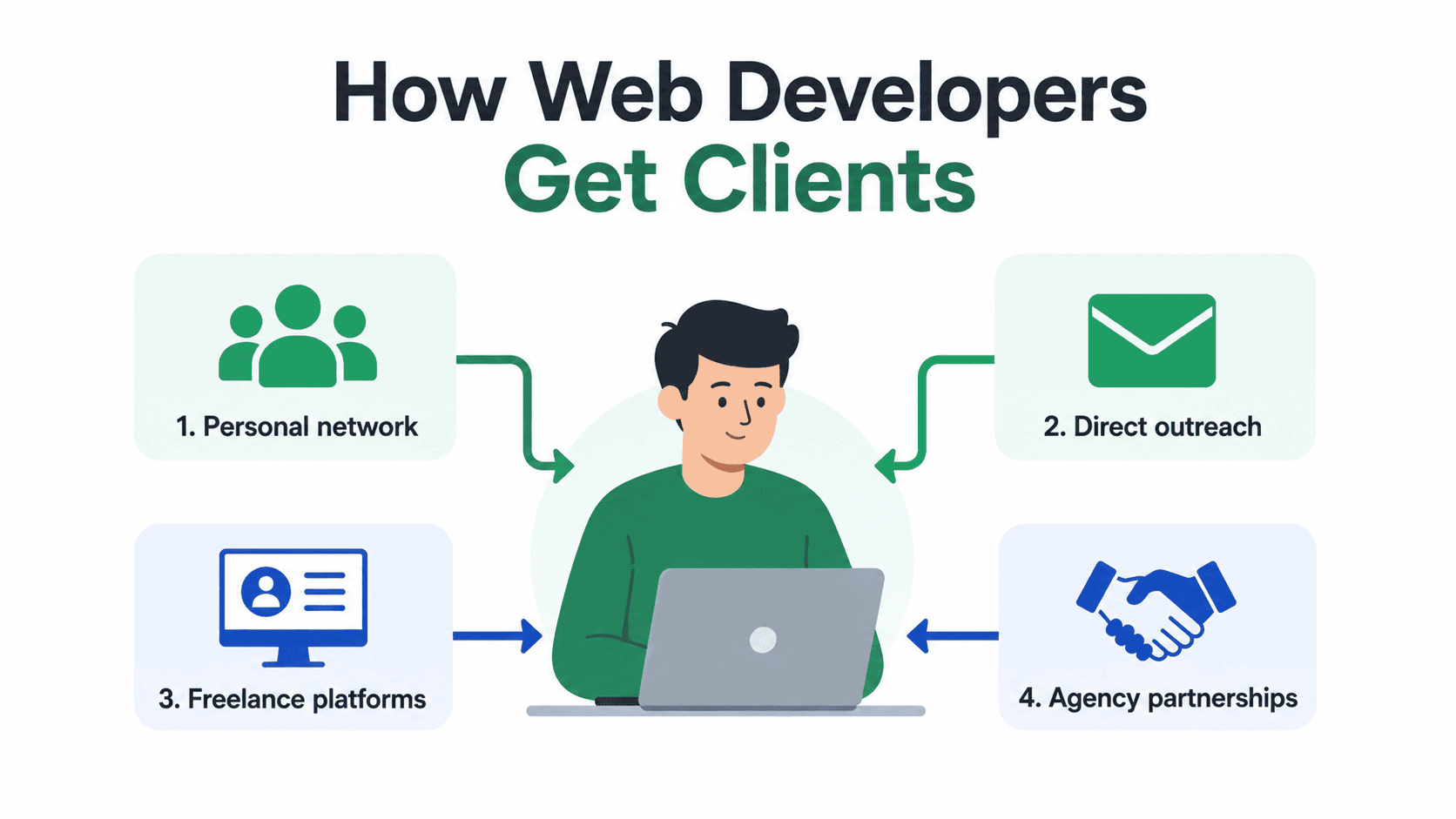
How Freelance Web Developers and Small Web Agencies Actually Get Clients
Quick answer: narrow what you offer and to whom, ask your existing network before doing anything fancier, treat freelance platforms as a backup channel rather than your main one, build a couple of referral and agency-partner relationships once you have a case study or two, and stay visible enough during a project that clients actually want to refer you afterward. The rest of this guide walks through each piece, plus a handful of tactics that don’t show up in most roundups.
Web developers and small studios are one of doBoard’s core audiences, so our team, together with CleanTalk (doBoard’s creator), regularly talks with them, not just about the product but about what’s actually hard in running a dev business day to day. Client acquisition comes up constantly, especially for solo contractors and small shops without a sales team.
So this time we asked directly: 32 freelance developers and small agency owners, mostly doBoard and CleanTalk customers, told us what actually works for them, and we checked that against relevant forum threads and recent industry writing. Some of what follows is familiar advice that still holds up in practice. Some of it is less obvious and rarely shows up in the usual roundups.
What should you fix before you start chasing clients?
Most of the wasted effort in client acquisition happens before a single email gets sent. A few things are worth fixing first.
Narrow your positioning, and pick a real axis to do it on.
“I build websites” competes with a global market. Developers we talked to tended to narrow down along one or two of these, rather than staying generalist:
· By industry. Dental practices, boutique law firms, D2C supplement brands doing $500K to $2M a year.
· By stack or platform. WordPress specialist work (custom themes, plugin development, Woo builds), Shopify Plus migrations, headless commerce on Next.js.
· By problem type. Legacy system migrations, Core Web Vitals and performance work, accessibility remediation.
· By client stage. Pre-seed startups that need a fast MVP versus established brick-and-mortar businesses (clinics, contractors, retail) modernizing a ten-year-old site.
Several developers said the switch from generalist to some combination of the above didn’t just improve reply rates, it also changed how they got quoted: a specialist is priced differently than a generalist doing comparable work. One WordPress specialist, we’ll call her Dana, a freelancer of six years, put it this way: “switching from ‘I do everything’ to ‘I fix broken WooCommerce checkouts’ didn’t just get me more replies, it doubled what I was comfortable quoting.”
Rebuild your portfolio around outcomes, not services.
A case study that leads with “Rebuilt checkout flow, cut cart abandonment 18%” reads differently than one that leads with “Responsive design, custom CMS, SEO optimization.” Client pain in the headline, technical detail in the body.
Claim your local listings if you take local clients at all.
This sounds basic and gets skipped constantly. A Google Business Profile with even a handful of reviews changes how a local business owner perceives you before you’ve said a word.
How do you land clients as a new contractor or young agency?
This section is for the stage where you have real work behind you, maybe years of it as an employee, but no independent, client-facing track record yet. That’s a different problem than “no experience,” and most generic advice doesn’t separate the two.
Ask your existing network directly.
Not a vague social post. A specific message to specific people: “I’m taking on two web projects this quarter, know anyone who needs a site rebuilt?” Several developers told us this alone got them their first paying client, and they’d skipped it for months out of a sense that it wasn’t a “real” way to find work.
Show the problem and the solution.
This can be a design mockup, or a technical read on what’s actually broken: a slow PageSpeed score, a checkout form failing silently, missing alt text, an expired SSL cert. Either way, translate it into what it costs the business, not just what’s technically wrong. “Your mobile checkout fails silently on Safari, and mobile is probably half your traffic” lands harder than “your Lighthouse score is 42.” A few developers went further and fixed one small thing for free before pitching anything, then sent a before-and-after alongside the write-up.
Record a short, personal video walking through a prospect’s actual site.
Two or three minutes, screen recording, pointing out specific things before any mention of hiring you. It reads as help first, pitch second, and several developers said the reply rate beats cold email by a wide margin.
Offer a small paid audit as the actual first project, not a loss leader.
Instead of pitching a full rebuild cold, sell a scoped, flat-fee technical health check (a few hundred dollars, a few days of work, a short written report) as the entire first engagement. It’s a much easier yes than a full project, it gets you paid from day one instead of working for free, and the bigger project tends to sell itself once the client has already seen your judgment on something small.
What are some client-finding tactics most guides skip?
Beyond the standard advice above, a few approaches came up in our conversations that rarely show up in blog roundups, likely because they take more setup than “post on LinkedIn.”
What are the best Upwork alternatives for web developers?
Upwork still gets the most traffic in this conversation, and several developers we spoke with still use it, but nearly everyone we talked to had at least one story about fee pressure, bidding wars, or an account restriction with no clear appeal process. Worth diversifying across a few of these, even just to have a backup pipeline:
None of these replace direct outreach or referrals. They’re worth treating as one channel among several, not the whole strategy.
How do partnerships create a repeatable pipeline of clients?
White-label development for marketing and design agencies. A lot of small marketing and branding agencies sell websites as part of their service but have no in-house developer. You do the technical work behind the scenes, they own the client relationship. It’s steady work once you find the right one or two partners, though it does mean giving up direct contact with the end client.
Cross-referrals with adjacent freelancers. Designers, copywriters, and photographers who serve the same type of client (say, boutique retail or professional services) run into the same clients you want. A standing arrangement where you send each other work costs nothing and compounds over time.
How do you turn one client into five through referrals?
A referral system works best as a repeatable process, not a hopeful afterthought. After every project wraps, ask directly, and give people a concrete reason to say yes: a discount on their next project, a small credit, or simply a specific ask (“if you know one other business owner who needs this, I’d appreciate the intro”).
One caution that came up more than once in our conversations: relying on referrals alone caps growth. It also narrows your pipeline to whatever niche your existing clients happen to know, which can quietly limit the kind of work you’re offered next.
Why do clients actually leave (and it’s rarely the work)?
A referral system only works if clients stick around long enough to want to vouch for you afterward. So it’s worth looking at why client relationships actually break down, because it’s almost never about code quality.
Several developers we talked to described a familiar pattern: they win a project, disappear for a week or two while writing specs or heads-down coding, and the client starts to panic. Not because the work is bad, but because they have no visibility into whether anything is happening at all.
What does the data say about client transparency?
This isn’t just anecdote. AgencyAnalytics’ benchmarking research found that 36% of agencies rank communication and transparency as the single biggest factor in client retention. Separately, 80% of clients said transparency is a crucial part of the relationship, yet only 56% said they actually had one. That gap between what clients want and what they get shows up in roughly a quarter of all client relationships.
That matched almost exactly what we heard directly. A good number of the developers we talked to described some version of the same thing: a client goes quiet for a few days not because anything’s actually wrong, but because they simply don’t know what’s happening, and that silence is what turns into a nervous email or an unnecessary “just checking in” call.
A few concrete things developers said actually help:
What does this look like in practice?
Point four is where doBoard actually fits, worth saying plainly since it’s our product. Each client can get their own fully separate workspace inside your account, its own projects, tasks, and people, kept isolated from every other client. You can spin up as many of these as you have clients, there’s no cap on how many, and if someone comes back a year later, everything from the last project is still sitting there waiting. It’s all included in one flat plan; the price only moves if you need more storage, not for more users or more clients.
We’re obviously not neutral here, and there are other decent project tools worth looking at too. But we do think doBoard is a genuinely good fit for solo contractors and small agencies specifically. Plans start at $5 a month with unlimited users and unlimited clients included, which is hard to find elsewhere at that price, especially if you’re just starting out and don’t want your tooling costs to scale with every new client you land.
FAQ
It varies a lot by how you go about it. Developers who started with their existing network often landed something within a few weeks. Cold outreach and platform profiles typically take longer, more like one to three months of consistent effort before the first yes, since you’re building trust from zero rather than borrowing someone else’s.
Most developers we talked to used a platform for their first few projects, then weaned off as referrals picked up. They’re a reasonable way to get initial reps and reviews, just go in expecting lower rates and more competition than direct outreach, and don’t plan to stay there long-term.
The developers who specialized earliest tended to get better-paying work sooner, but it’s easier to pick a real niche once you’ve done a range of projects and know what you actually enjoy and are fast at. A reasonable middle ground: stay generalist for your first handful of projects, then narrow once a pattern shows up in what you’re good at and what clients keep asking for.
For a solo developer doing meaningful custom work, two to four active client projects is a common range before quality or communication starts slipping. Retainer or maintenance-only clients can stack higher than that, since they take far less active attention per client.
Yes. Full-time or contract employment, building and selling a productized service or template, and revenue-share partnerships with agencies are all common paths alongside direct client work. This guide focuses specifically on the client-acquisition side, since that’s what most solo developers and small agencies deal with day to day.